Sunday, 3 July 2016

And we are starting!

We are starting our 2016 fieldwork in Vestmannaeyjar of 1 month… This fieldwork will be a collaboration between the Marine Research Institute and the University of Cumbria. This last couple of days have been full of team members arriving and setting up equipment! We still have some work to do on land before we get on the boat… But just yesterday some killer whales were sighted close to the main island Heimaey where we are staying! So things look promising here and we are very excited to start!

This season we will be collecting photo-ID data, behavioural observations, sampling feeding events, biopsy samples, acoustic recordings and land-based observations. With this we investigate the distribution and movements, social and acoustic behaviour and foraging ecology of the Icelandic killer whale population.

We’ll keep you posted on the progress of the fieldwork through the next weeks! Here are some pictures from these first days from Marie Louis, who's joining us this year.

The view from Heimaey. Photo by Marie Louis.

Minke whale seen from land. Photo by Marie Louis.

Killer whales seen from land. Photo by Marie Louis.

Killer whales seen from land. Photo by Marie Louis.

Team members scouting for whales! Photo by Marie Louis. 

The midnight sun in Heimaye. Photo by Marie Louis.


Killer whales seen from land. Photo by Marie Louis.

Puffin. Photo by Marie Louis.


Tuesday, 14 June 2016

DNA can say so much...

Commentary by Sara Tavares

The amazing work done for more than 20 years in British Columbia, photographing and identifying (all) killer whales, gave us unprecedented knowledge about this species. The detailed photographic dataset created in British Columbia is invaluable for the conservation and monitoring of the local populations.

But sometimes photographic identification is not enough and other kinds of information from the individuals becomes important, such as its specific genetic "fingerprint" - DNA.

This blog post by Dr. Carla Crossman, molecular and marine biologist with the Vancouver Aquarium Marine Science Centre’s Coastal Ocean Research Institute, is a great example of how invaluable genetics studies are when working with wild populations. Last April, 2 dead individuals washed out in British Columbia in a state of decomposition that did not permit identification based on appearance. But using existent knowledge of the genetic variation across populations, the Vancouver Aquarium Marine Science Centre’s Coastal Ocean Research Institute discovered to which population the individuals belonged to by their genetic code. Working long hours to get this information as soon as possible, the molecular biologists in the Institutes’ Conservation Genetics Lab were able to tell that both whales belonged to the fish-eating resident population and more specifically to the southern community! Amazing, right? This was possible due to previous studies by Dr. Lance Barrett-Lennard, currently senior marine mammal scientist at the Vancouver Aquarium Marine Science Centre’s Coastal Ocean Research Institute, that discovered which variations in the genetic code distinguished the killer whale populations.


3 males traveling together. Are they from the same family and therefore genetically related? Uncovering this is one of the goals of the Icelandic Orca project.


We are currently working on building up this kind of genetic knowledge on the Icelandic killer whale population to help us monitor the status of the population. One of the goals of our project is to map the genetic relatedness among individuals and understand the genetic variability within the population. It will be some years until we uncovered all this but during the last 2 years we made great progress collecting small biopsy samples of skin from photo-identified individuals. Lately, we have been trying to find the best genetic markers to use on this population (because the variations in the genetic code are not the same among populations) so that we can start uncovering this vital information about the animals.

But, as Carla Crossman so well shows on her blog post, genetic analysis can be a slow process... Even just extracting DNA from a small piece of skin from a single individual whales takes several days! And extracting DNA is just the very first step! Then you need to test different genetic markers, optimise protocols and only once all that is complete can you start going through all the small skin biopsies to start gathering information from different individuals. So it can usually be many months until this type of analysis is complete. We will keep you posted about new developments on the very exciting genetic studies being conducted!

Thursday, 28 January 2016

My Icelandic orcas' experience

Commentary by Julie Beesau


Julie Beesau spent 2 fieldseasons volunteering with us at the Icelandic Orca project in 2013 and 2014. This blog post is about her own experience working with Icelandic orcas.

I have spent two months in Iceland, in Grundarfjörður, during winter fieldwork twice (in 2013 and 2014) with all the Icelandic Orcas' team. It was such a great experience for me. I've always wanted to see orcas in the wild and study them. I learned many things on their social and feeding behavior, and I could also enjoy the magic of their acoustic communication.
I was in charge of taking pictures and acoustic recordings on the whale watching boat. It was also nice to discuss and explain to tourists what kind of studies we can do on orcas.
I remember one day we encountered more than 100 orcas in the fjord, it was just unbelievable. I think this day was my favorite and will be engraved in my memory forever.

Male orca. Photo by Julie Beesau.


Every day after the trip on the whale watching boat I would meet the rest of the team in our house where we shared our sightings and experiences on the boat and also a great meal.

Landscape of  Grundarfjörður. Photo by Julie Beesau.
I could also appreciate the magical landscapes of Iceland and sometimes the capricious weather.
It was a unique experience, rich in animal sightings but also rich in human contact. I met some absolutely lovely and very helpful people there (Icelandic, Portuguese, Russian, Italian, Scottish, Dutch, German people).

Thank you to all the Icelandic Orcas’ team and also to Láki Tours, especially captain Gísli.


Wednesday, 20 January 2016

Do whales have culture?

Commentary by Sara Tavares

What is culture? Is culture something that makes us, humans, special?
This was the theme of the last Café Scientifique meeting I attended, a monthly evening public meeting in a café/bar where scientists are invited to talk about their work or another interesting topic. In the last one I attended in St Andrews, Luke Rendell talked about his latest book, co-authored with Hal Whitehead, "The cultural lives of whales and dolphins", on the theme of culture in cetaceans.

So, what is culture? 
How to define culture has been one of the biggest academic discussions. Culture is not genetic, is not in the DNA. Broadly, culture is the accumulation of knowledge that is passed across generations over time.
Different sperm whale populations have different codas (stereotyped pattern of clicks) and in the Pacific different social groups make different codas and some groups share the same dialect and temporarily spend time together. This is part of the cultural identity of these whales and is not genetically transmitted, since genetic studies showed a mix of genes between groups that mismatch the dialect pattern.

This is just one example for one species that shows the existence of culture in cetaceans. Culture is probably vital for highly social animals such as cetaceans. One of the stories presented in the Café Scientifique meeting as an interesting example of the importance of cultural identity in whales was the story of Keiko, the Icelandic killer whale. Keiko was captured when he was around 2 years old and kept for many years on his own in a small tank. 

 
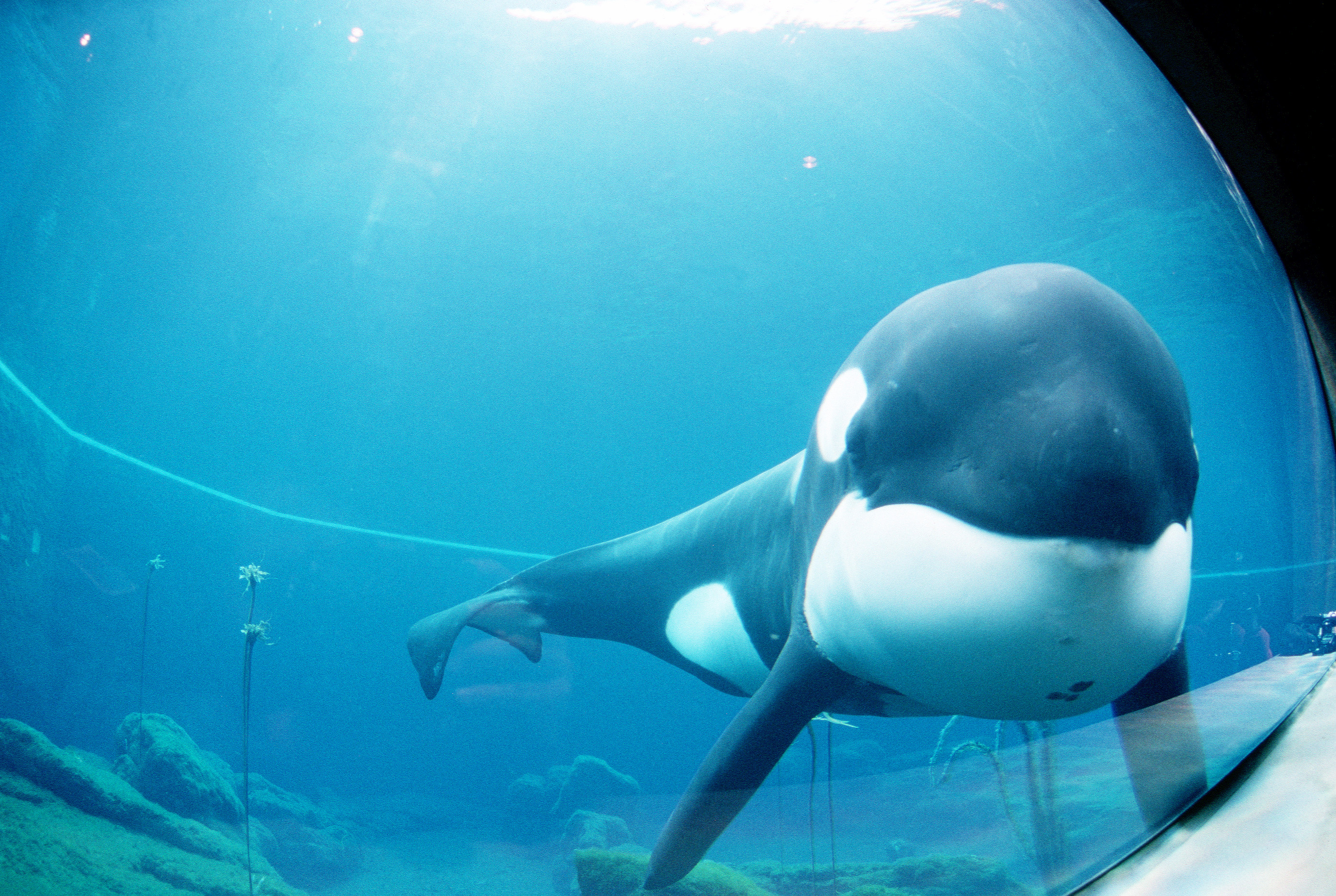
The killer whale Keiko, star of the film Free Willy (source: Wikipedia)


When adult, Keiko was gradually freed in Vestmannaeyjar (where we conduct our fieldwork in the summer), first kept in a sea pen for habituation. In one occasion, when Keiko was accompanied by a boat with people involved in his re-introduction , he was approached by one killer whale that tried to interact with him going "belly to belly", a common social behaviour among whales . However, Keiko quickly swam away from the whale and "hid" behind the boat, possibly scared by that unfamiliar behaviour.  After full release, Keiko eventually swam to Norway where he was adopted by a fishing village and fed by humans, until he eventually died, probably from pneumonia.

Keiko couldn't be re-introduced in the Icelandic killer whale society because, after being apart from these whales since a very young age, he didn't know the culture.

Although this is just one single story of only one whale it can still suggest to us how important culture might be for cetaceans. So maybe the question shouldn't be how to define culture but how many forms of culture there are. Because human culture and whale culture are not the same, but they both exist and they are both unique.

Café Scientifique is currently active in more than 40 towns across the UK and in some cities in other countries. Check out on their website where and when is the next meeting in your town and join the discussions!

Monday, 11 January 2016

Goodbye 2015... Hello 2016!


Another year has passed... And what a year for the Icelandic Orca project. We had some amazing fieldseasons this last year, interesting findings about this unique population (you can get a full list of our project's publications to date here) and lots of new cool stuff for the project (new website, new logo and Mousa).

As "a picture is worth a thousand words" we selected some photos to share with you of moments to remember from 2015. 

We want to thank everyone who collaborated with and supported the project and that was involved in making 2015 a year full of great developments!

Thank you for the support during the past year. We are looking forward for a 2016 full of new discoveries about Icelandic orcas and to share them with you all!


...

Monday, 28 December 2015

My 2015 SMM conference experience report

Commentary by Sara Tavares

The Society for Marine Mammalogy (SMM) held its 21st Biennial Conference on the Biology of Marine Mammals 1 week ago in San Francisco, California (USA). The theme of the conference was "Bridging the past with the future", focusing on the past and future of marine mammal science in a changing world. This SMM conference was the biggest so far, with 1,536 abstracts submitted and over 2,200 registrants!

There were workshops, oral and poster presentations on a great variety of themes: conservation, distribution and abundance, behaviour, polar ecology, health, population assessment, ecology, climate change, acoustics, physiology, foraging ecology, human dimensions, population biology, genetics, biology, anatomy, evolution and education and communication. All the invited plenary talks were brilliant and very inspiring. Also, during the whole conference week there were a variety of art work in exhibit and special events to join.

SMM San Francisco City Hall birthday celebration (photo by Tomoko Narazaki)

Personally, it was my first SMM conference and I absolutely enjoyed it. It was overwhelming the size of the conference, with so many people attending and so many presentation sessions at the same time. But it was also great opportunity to see friends and colleagues, meet so many interesting scientist and discuss your work with others. We had the chance to choose which presentations to attend from a variety of highly appealing options of topics, species and locations around the world. We got to see fascinating research about orcas in various subjects from acoustics to interactions with fisheries and genetics.

Sara Tavares's oral presentation "The social structure of the Icelandic killer whale (Orcinus orca) population" at the 2015 SMM conference

It was very gratifying to be able to present part of my PhD study on the social structure of the Icelandic orca population. Thank you to the SMM organizers for making this such a great meeting of marine mammal scientistsThis was an amazing and fruitful experience  that I hope I can repeat in 2 years again!

Wednesday, 11 March 2015

The herring

To better understand the orcas we also have to understand their environment and, specifically, what they are feeding upon. And in most places where we study them their main prey is an abundant silver fish: herring.

Photo by Filipa Samarra
Herring is the unsung hero of this ecosystem. It supports the whales; in groups the whales encircle schools of herring and using their tails they slap a bunch of herring that gets stunned allowing the whales to feed on it one by one. But not all the stunned herring is eaten by the whales, so when the whales are feeding some uneaten herring floats to the surface. Seagulls and fullmars are quick to catch these and take advantage of the whales' work.
Photo by Sara Tavares
Then there are the beautiful gannets. They wait until the whales have rounded up a nice ball of herring and then plunge the water in pursuit of some fish too. It is an incredible sound hearing a group of gannets simultaneously diving into the water. And we always wonder how they don't hit the whales and well...sometimes they do!
Photo by Sara Tavares
And of course there are also the sea eagles we see in the winter and the skuas we see in the summer. But it's not just birds, we also see white-beaked dolphins and seals in the area, which are probably also getting their fare share of the silver prey. And there's also all the unseen fish, like cod, preying on herring.
Photo by Leticiaà Legat
Photo by Miguel Neves
Photo by Marjoleine Roos
Photo by Sara Tavares
Although many different species can depend on herring, the herring itself is a tricky prey and this year we have seen how the herring distribution can quickly change. Up until 2014, there was a huge amount of herring overwintering in the fjords of Grundarfjörður and Kolgrafafjörður. But this year although the herring stock estimates indicate it is still quite a healthy stock, the amount of herring present in this area is much smaller. This is because the majority of the stock is spending the winter in the offshore waters further West. In fact the herring only started coming to this area in large numbers in 2006, following yet another shift in its distribution (see this study for more information). 


It is quite a mystery exactly why herring shifts its overwintering location. During winter, herring doesn't feed and it is mainly trying to avoid spending energy or being predated, and it often chooses coastal areas to do so. It is not possible to predict how long the herring will remain offshore or even what proportion of the stock will do so. It could be that in the winter of 2016, a large proportion of the stock once again travels to the fjords to overwinter, as it did in the last few years. 

Interestingly, it seems that it is during winter that the herring aggregates in higher numbers in relatively small areas. Throughout the rest of the year, the stock can be much more dispersed. And with the herring come the whales, so it is no surprise that it is in the winter months that we can see the largest aggregations of whales too. In fact, it is only in winter that some individuals can be seen around Iceland, as it seems that during summer they go elsewhere (see our post about matches to Scotland). So there is a lot that can be learnt about orcas by having the herring in accessible locations during winter, as only then can we follow the lives of some whales. 

So we keep our fingers crossed that this has been an odd winter, and that next year the herring return to familiar shores!